

HISTORY
The Francini Estate,
The Golden Age of the King’s Fountain Engineers,
1607–1768


The Francini Dynasty
The cradle of the Francini family for five generations, the Château de Grand'Maisons was the fiefdom of these illustrious Florentine fountain engineers, creators of the water features (jeux d'eau) at Versailles, Saint-Germain-en-Laye, and Fontainebleau. From the acquisition of the lands in 1607 by Tommaso Francini to the major hydraulic achievements of his successors, the estate embodied the excellence of the Crown's master hydrologists for over a century, blending technical ingenuity with the art of seigneurial living.
From the Splendor of Louis XV to a Providential Rescue
In the 18th century, the estate entered a new era: elevated to a County, it saw the construction of a "Château Neuf" (New Château) under the impetus of François-Henry de Francine and the architect Jean-Baptiste Leroux, before being integrated into the Royal Hunts of Louis XV, King of France, in 1768. Sentenced to demolition by the State Council to replenish the Kingdom's coffers, the building owes its exceptional survival to the King's architect, Jean-François Heurtier. He purchased it in 1779 to preserve its splendor, passing down to us this unique witness to the history of France.
I. Tommaso Francini,
The old Château


Tommaso Francini (Frenchified as Thomas Francine), born on March 5, 1571, in Florence and deceased on April 15, 1651, in Saint-Germain-en-Laye, was an Italian hydraulic engineer, architect, and scenographer.
A true visionary in water management, he is famous for introducing Renaissance Italy's expertise in automatons and water features (jeux d’eau) to France. Upon settling at Court, he founded a lineage of "Intendants of the King’s Waters and Fountains" who would design and maintain, across four generations, the gardens, waterfalls, basins, and fountains of the great royal estates of Saint-Germain-en-Laye, Fontainebleau, and Versailles.
The story of Tommaso Francini and his descendants is also intimately intertwined with the estate of Grand'Maisons.
The Origins of Grand'Maisons
According to archives from 1566—the oldest discovered on the site to date—the first known owner of the Grand'Maisons lands was Guillaume Le Thelier. Later, his descendant Jehan Bertin built a manor house there. This very building would serve as the starting point for the future estate of the Francine family.
A Temporary Mission Extended by Royal Decree
In the late 1590s, as part of diplomatic and cultural exchanges between Florence and France, Tommaso Francini was sent by the Medici family to King Henri IV. Initially, this journey was intended only as a temporary mission to modernize the royal residences.
However, deeply impressed by the quality of his work and eager to ensure the successful development of his gardens, King Henri IV expressly requested that he remain in France under his service. Francini settled permanently and spent the rest of his life in France. He put his skills at the service of Henri IV, and later his son, King Louis XIII, who officially granted him the exclusive title of Intendant général des eaux et fontaines de France (General Intendant of the Waters and Fountains of France) in 1623. His position at Court was further strengthened under the regency of Marie de' Medici, who hailed from the very Florentine family he had served in his early career.
Establishing the Dynasty in Villepreux
On June 20, 1607, Tommaso Francini acquired the lands of Grand'Maisons. This purchase marked the beginning of a five-generation Francini lineage on the estate. Alongside his major projects for the Crown, Francini put his expertise at the service of the high French nobility, designing hydraulic systems and parks in the suburban regions of Paris.
As early as 1611, Thomas Francine undertook extensive reconstruction and transformation work on the original Bertin house to turn it into a small château (the Château Vieux), flanked by a dovecote bearing the Francini coat of arms. During this period, he designed water features and waterfalls for his private garden, a hydraulic layout whose arrangement is confirmed on historical maps up until 1744.
Expansion and Seigneurial Roots
In 1633, the locality of Grand’Maisons was officially enfeoffed to the chatellany of Villepreux. Now a local lord (seigneur), Thomas Francine expanded his property. Between 1633 and 1645, he acquired the remaining adjacent plots to the Grand'Maisons estate, enlarging his park to create a grand French-style garden (jardin à la française).
Major Achievements and Technical Contributions
-
The Terraces and Grottoes of Saint-Germain-en-Laye: His first major French project under Henri IV. Francini designed a series of six terraces descending toward the Seine, housing grottoes animated by hydraulic automatons.
-
The Arcueil Aqueduct: To supply the Luxembourg Palace and its gardens commissioned by Marie de' Medici, Francini oversaw the construction of a 13-kilometer-long aqueduct linking Rungis to Paris, enabling the operation of the Medici Fountain.
-
The Foundations of Versailles: Toward the end of his life, he laid the technical groundwork for the earliest water supply systems for Louis XIII’s hunting lodge in Versailles.
-
Court Scenography: Francini introduced changing backdrops and mobile special effects to France, designing complex stage machinery for royal ballets.
Legacy
Thomas Francine passed away in 1651. While his name remains forever linked to the grand royal parks, his legacy also endures through the Château de Grand'Maisons, which he built. His son François and his grandsons would succeed him in his royal duties, becoming the masterminds behind Louis XIV's hydraulic networks at Versailles, all while maintaining their family roots on the lands of Villepreux.
II. François Francini,
Boundless Creativity


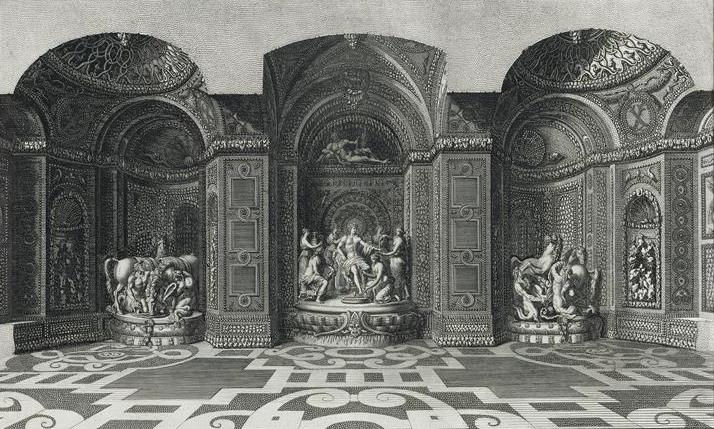


While the dynasty established its roots at Grand'Maisons as early as 1607, François de Francine remains its most iconic figure. Born in Paris, he inherited the exceptional expertise of his father, Tommaso, the Florentine engineer who had introduced the art of grottoes and water features to France. Under the personal reign of Louis XIV, François elevated this heritage to its absolute zenith, transforming engineering into a powerful instrument of showmanship for absolute power.
The Master of the Waters of Versailles
Appointed Intendant général des Eaux et Fontaines de France, François de Francine was the man who made the Sun King’s hydraulic dream a reality. He had to overcome a challenge deemed titanic at the time: making water spring forth on the Versailles plateau, a marshy site completely lacking any nearby river.
To tame this uninviting landscape, he pioneered a major technological revolution: the invention of cast-iron pipes. Replacing fragile lead conduits, cast iron could withstand colossal pressure, allowing for water features of unprecedented height and power. His most famous achievements stand as a testament to this mastery:
-
The Grotto of Thetis (1664): A masterpiece of decorative hydraulics. In collaboration with Denis Jolly —former fountain-maker to Nicolas Fouquet at Vaux-le-Vicomte—he designed a complex mechanical system that animated automatons and a hydraulic organ. Although demolished in 1676 to make way for the prestigious Ambassadors' Staircase, the memory of this marvel remained etched in the minds of the 17th century.
-
The Dragon Fountain (Bassin du Dragon): A display of sheer brute force, where he propelled a central jet to a height of 27 meters—a 17th-century power record.
-
The Ballroom Grove (Bosquet des Rocailles): He developed tiered waterfalls where the water, cascading over millstone and seashells, was precisely calibrated to produce a specific acoustic tone to accompany the royal orchestras.
-
The Latona Fountain (Bassin de Latone): The centerpiece of the Great Perspective. Francine organized a complex underground network to supply the seventy-four water jets that brought the solar myth to life.
A Trio of Genius in Service to the Crown
Alongside the landscape architect André Le Nôtre and the First Painter Charles Le Brun, François de Francine formed an inseparable trio. His role was to "breathe life" into Le Nôtre’s designs: for every fountain, Francine calculated gradients, flow rates, and pipe diameters to ensure each jet reached the exact height demanded by the King.
Ennoblement and Deeper Roots at Grand'Maisons
It was under his leadership that the family permanently elevated its social standing. In 1635, the lineage was officially ennobled, transitioning from brilliant engineers to the "noblesse de robe" (nobility of the robe) and high servants of the State.
This social ascension culminated in 1663 when François officially became Seigneur de Grand'Maisons (Lord of Grand'Maisons), swearing fealty (rend aveu) for the land to the lord of Villepreux. This legal act sealed the family’s integration into the local seigneurial hierarchy. At Grand'Maisons, François consolidated the family fiefdom, paving the way to pass down his royal duties to his son, Pierre-François.
A Character of Absolute Rigor
Described as a man of legendary discretion and absolute rigor, he lived completely devoted to the service of the King. He divided his time between his offices in Versailles and his estate of Grand'Maisons, which he deeply cherished as a peaceful haven, far from the perpetual roar of the royal fountains. He left behind a legacy so robust that some of his cast-iron installations served the Versailles park for over two centuries.
Mastering Scarcity: The Illusion of Abundance
Supplying the fountains with water was a constant preoccupation for the King and his fountain engineers, so much so that a colossal project was conceived to divert the Eure River via an 80-kilometer-long canal. Though this monumental undertaking was never completed, it illustrates the sheer scale of the estate's hydraulic needs. A complex network of aqueducts and reservoirs—both underground and above ground—was designed for leagues around Versailles. From Rambouillet to the Seine, where the famous Marly Machine was built, all surrounding ponds and rivers were harnessed to feed the park, yet they never fully satisfied the consumption of the water jets.
This structural scarcity forced the Francines to master the art of conservation and illusion. Unable to maintain a continuous water flow across the entire estate simultaneously, they introduced a system of alternating circulation: the fountain-makers would only open the valves of the basins as the King approached. A whistle blast served as the signal to activate or halt the water features, orchestrating a theatrical abundance that followed the royal procession. This resource dilemma, which no major project ever permanently solved, remains one of the greatest challenges in historical garden preservation today.
III. Pierre-François de Francini,
The Elevation of Grand'Maisons to a County


The Golden Age of Versailles’ Waters
Son of François de Francine and grandson of Tommaso, Pierre-François de Francine succeeded his father in the prestigious position of Intendant général des Eaux et Fontaines de France. Under his leadership, the hydraulic network of Versailles reached its absolute zenith and maximum complexity, counting over 1,400 water jets that he coordinated with absolute rigor.
Collaboration with Jules Hardouin-Mansart
His role extended far beyond simple maintenance; he was the guarantor of the system's longevity. Pierre-François notably supervised the maintenance and optimization of the Parterre d'Eau reservoirs—those vaulted underground ashlar stone cisterns that formed the beating heart of the royal estate. Collaborating closely with the First Architect Jules Hardouin-Mansart, he ensured the water supply for the new groves created at the end of Louis XIV's reign, such as the Colonnade and the Bosquet des Dômes (Domes Grove).
A Strategic Exchange with Louis XIV
The year 1707 marked a historic turning point for the family and the estate of Grand'Maisons. In an act of high royal favor, Pierre-François entered into a strategic exchange with King Louis XIV: he traded his Ferme des Graviers (Graviers Farm), located within the very grounds of the Versailles park, for the lordship and chatellany of Villepreux, as well as the lands of La Hébergerie (excluding the old château and the Gondi park).
The Creation of the County of Villepreux
On April 8, 1707, this transaction culminated in the elevation of the lordship into a county under the name of Villepreux. Pierre-François thus became the 1st Count of Villepreux, permanently anchoring the Francine dynasty at the summit of the aristocratic hierarchy. At Grand'Maisons, he maintained the splendor of the manorial residence, meticulously preserving the gardens and spectacular hydraulic installations inherited from his ancestors.
The Last Guardian of Family Expertise
His passing in 1720 marked a major transition. His son, François-Henri de Francini, succeeded him and shortly thereafter undertook the removal of the old water features to dedicate himself to the architectural project of the "Château Neuf". Pierre-François thus remains in history as the last great guardian of the family’s hydraulic expertise applied to the lands of Grand'Maisons, just before the estate became the heart of a prestigious county.
IV. François-Henry de Francine,
The Beginnings of the Château Neuf


Succeeding his father in 1720 as Count of Villepreux and Intendant général des Eaux et Fontaines, François-Henry de Francine (1684–1775) represents a distinct turning point in the history of Grand'Maisons. While his ancestors were masters of water, he would be a man of stone and high society.
The Radical Transformation of Grand'Maisons
Upon taking over the estate, François-Henry made a powerful, symbolic decision: he ordered the demolition of the old hydraulic installations and Italian-style gardens created by his great-grandfather Tommaso. This choice marked the end of the "engineers'" era: Grand'Maisons was no longer to be a technical laboratory, but a modern, stately residence.
Around 1730, he launched the construction of a majestic new residence, a château "à la moderne". For this ambitious project, he commissioned the architect Jean-Baptiste Leroux, one of the most prominent names of Rococo architecture in Paris. Designed to rival the finest country houses (maisons de plaisance) of the era, this new château was characterized by an elegant, symmetrical architecture typical of the 18th century, reorienting the estate toward courtly life and grand entertainment.
A Great Officer of the Crown
Although he inherited and retained his position as Intendant of the Waters, his role was now more administrative and political than technical. He became an influential figure at the court of Louis XV. Under his aegis, the Francine name permanently left behind the mud of construction sites to secure its place in the registers of the high nobility.
Financial Decline
However, François-Henry’s splendor came at a steep cost. The construction of the Château Neuf and the family's lavish lifestyle began to weigh heavily on the Francine finances. While the estate of Villepreux shone brightly, it fell deeply into debt. Upon his passing, he left behind a prestigious yet fragile estate, which his son, Honoré de Francini, would ultimately be forced to sell to King Louis XV in 1768, bringing the dynasty’s presence at Grand'Maisons to a close.
V. Thomas François Honoré de Francine,
The Last of the Francini Dynasty at Grand'Maisons


Thomas François Honoré de Francine (1724–1778), son of François-Henry, was the final representative of the dynasty to bear the title of Seigneur de Grand'Maisons. His destiny was that of a grand lord caught between the heritage of an illustrious name and the financial collapse of the family estate.
Exercising the Final Royal Duties
-
A Career in Service to the Crown: True to family tradition, Thomas François Honoré held the position of Intendant général des Eaux et Fontaines de France. He served under the reign of Louis XV, though his role had become almost exclusively administrative. While the title remained highly prestigious, the era of great hydraulic innovations had passed. He moved within the highest echelons of the Court, dividing his time between his obligations in Versailles and his lands in Villepreux.
The Burden of an Unfinished Legacy
Upon his father's passing, he inherited a complex situation. The Grand'Maisons estate was dominated by the imposing site of the "Château Neuf", which remained unfinished and uninhabitable. Thomas François Honoré found himself at the helm of an estate that was immense in appearance—the County of Villepreux—but heavily burdened by the colossal debts accumulated over the preceding decades. The splendor of the Francine family, which had reached its zenith under Louis XIV, now collided with a precarious economic reality.
The Cession of the Estate to Louis XV
The definitive turning point came in 1768. Faced with the impossibility of restoring the family finances and completing the construction of the château, Thomas François Honoré resolved to sell the land and County of Villepreux, including Grand'Maisons, to King Louis XV. Motivated by the urgent need to liquidate debts, this sale marked the end of 160 years of continuous Francini presence on these lands.
The End of a Manorial Lineage
Following the sale, Thomas François Honoré moved away from Villepreux. He passed away in 1778, ten years after parting with his family’s French cradle. Although he retained his titles of nobility, he was no longer the landed lord his ancestors had been. With him, the physical presence of the Francine family at Grand'Maisons came to an end, leaving behind a name forever inseparable from the history of water at Versailles, and an estate destined to pass into the hands of the Crown, and later, new owners after the French Revolution.
VI. Louis XV, "The Beloved"
The Royal Hunts
The Estate Under Louis XV: Integration into the Royal Hunts
Under the reign of Louis XV, the destiny of Grand'Maisons became directly integrated into the sovereign’s personal estate. In 1768, the King acquired the property to incorporate it into the vast network of the Royal Hunts (Les Chasses Royales), a prestigious territory that spanned over 6,500 hectares around Versailles. Louis XV was drawn to the strategic location of the Grand'Maisons estate and the abundance of its game (the rich hunting potential of the land).
The estate thus became an essential link in the King’s hunts and pleasures, fully embedding itself within the preserved landscape surrounding the Court of Versailles.
A Historical Paradox: Royal Prestige and the Threat of Destruction
This period of royal management placed the estate on a dual trajectory:
-
The Landscape's Imprint: Integration into the Royal Hunts permanently bestowed upon Grand'Maisons its aura as a royal land. The estate's status still shapes the nobility of its vistas today, as well as the layout of its grand avenues, which were adapted at the time for the passage of hunting carriages.
-
The Threat to the Architecture: Paradoxically, this desire for state control and the exclusive focus on hunting grounds almost caused the loss of the château. With priority given to the forests and game, the buildings and the small château built by the Francini family were neglected by the royal administration, suffering from a lack of maintenance that directly threatened the building's survival.
Nevertheless, Grand'Maisons managed to weather this management crisis, preserving its principal structures and its historical layout.
VI. Jean-François Heurtier,
Grand'Maisons Saved from Destruction


The Estate Confronting the Revolution: The Threat of Demolition (1779)
The history of Grand'Maisons almost came to a definitive end in 1779. The Kingdom of France, strangled by the debts of the American Revolutionary War, was seeking every possible means to replenish its coffers. Since the Château de Grand'Maisons belonged to the Crown Land (Domaine de la Couronne), it was legally inalienable and could not be sold. To circumvent this rule and raise immediate cash, the State Council ordered the demolition of the building in order to sell its materials (ashlar stone, slates, woodwork) separately.
The Providential Intervention of Jean-François Heurtier
It was in this critical context that Jean-François Heurtier (1739–1822) intervened. Leveraging his status as the King’s Architect, he used his insider knowledge to halt the destruction of the estate. He purchased the condemned building using his own personal funds.
Together with his wife, Heurtier undertook extensive interior finishing and structural work. They transformed the estate—which the King had used exclusively for his hunts without ever maintaining it—into a truly comfortable and liveable country house (demeure de plaisance).
Political Instability and the Transition to the Bertin de Veaux Family
The economic and political instability of the era marked the beginning of a rapid succession of owners:
-
1802: Heurtier sold the château to Pierre Jacques Dubois-Desmeures.
-
1811: Ruined nine years later, Dubois-Desmeures was forced to sell the estate at auction. The buyer was Thomas-Jean-Baptiste Merlin.
This acquisition by Merlin proved providential: he was the godfather of Augustine Bertin de Veaux. It was through this bond of kinship and trust that Grand'Maisons officially entered the orbit of the de Veaux family. The estate, though still incomplete, was thus saved and preserved until Augustine formally took over the reins in 1828 to bring the great work to completion.