

HISTORY
The Château des Bertin de Veaux, from 1811 to the Present Day


The Legacy of the Bertin de Veaux: Politics and Heritage
In 1811, the estate entered a new era when it was acquired by Thomas Jean-Baptiste Merlin, a Parisian art collector and stockbroker, before being bequeathed in 1826 to his goddaughter, Augustine Bertin de Veaux. Married to Louis-François Bertin de Veaux—a major political figure and co-founder of the Journal des Débats—she oversaw the completion of the château's construction, scrupulously respecting the original 18th-century plans. Grand’Maisons became a prominent hub of 19th-century intellectual and artistic life, welcoming illustrious guests such as Chateaubriand and adorning its walls with portraits by the greatest masters, from Ingres to Girodet.
Two Centuries of Succession: From the Resistance to Renewal
For nearly two hundred years, the same family line has watched over this heritage, weathering the trials of history. This dedication is exemplified by Count Roland de Saint Seine, a Resistance hero who was deported and later honored with the Legion of Honor. Pioneers in opening the estate to events as early as the post-war period, the descendants—from Simone de Saint Seine to Victoire and Lutz Liebrecht today—perpetuate this tradition of excellence. Through major restorations and the project of the new Orangerie, they are breathing new life and brilliance into this architectural jewel, thereby securing the future of this "second family stronghold."
I. Monsieur et Madame Merlin,
The Unification of the Estate


Monsieur Thomas-Jean-Baptiste Merlin
painted in 1820 by Martin DRÖLING
Monsieur Thomas-Jean-Baptiste Merlin
painted in 1789 by Anne-Louis GIRODET-TRIOSON

Madame Bocquet with the Green Shawl,
painted in 1804 by Anne-Louis GIRODET-TRIOSON
.jpg)
Madame Merlin with the Yellow Shawl,
painted in 1810 by Anne-Louis GIRODET-TRIOSON


Self-portrait,
painted in 1791 by Martin DRÖLING
Self-portrait,
painted in 1795 by Anne-Louis GIRODET-TRIOSON
1811: The buyout of the château and the reconstitution of the historic fiefdom
The year 1811 marked a decisive turning point in the property's history. The Château de Grand’Maisons and its outbuildings were sold at auction before the Court of First Instance of the Seine for the sum of 28,050 francs. The buyer, Thomas Jean-Baptiste Merlin (1750-1826), was a prominent figure of the Parisian upper bourgeoisie: formerly the Receiver General of Estates and Forests for the generality of Alençon, he had become a stockbroker, collector, and aesthete.
This acquisition took on a unique heritage dimension thanks to his wife, Marie-Françoise Tricard (1753-1816). Hailing from a wealthy Parisian family, she had acquired the Grand’Maisons farm, located on the lands of the former royal lordship of Villepreux, in February 1798 with her first husband, Louis Michel Bocquet. What had initially been a simple financial investment for the Bocquet couple—who had temporarily retreated to their country house in Meudon to escape the Revolutionary riots—became a long-term project. By 1803, Marie-Françoise had purchased the Dauphin grove (known as the Saint-Fiacre wood) and rebuilt the farmer's dwelling.
After becoming a widow, she married Mr. Merlin in 1808, bringing these agricultural lands with her. Thus, the buyout of the château by her new husband in 1811 allowed for the reconstitution of the old fiefdom as it had been originally designed by the Francine family in the 17th century, gathering together what the vagaries of history had scattered.
A haven of stability immortalized in paint
Monsieur and Madame Merlin belonged to that generation of the wealthy bourgeoisie whose lives were shaped by the upheavals of a transforming France. Having lived through the Ancien Régime, the French Revolution, and the Empire, they saw Grand'Maisons as a promise of permanence. In a France of short-lived political regimes, they turned the estate into a haven of stability. This life trajectory and the endurance of their status are spectacularly reflected in art history through the couple's portraits:
-
Marie-Françoise, immortalized by Girodet: She had the privilege of being painted twice by the famous Neoclassical painter Anne-Louis Girodet. The first time was in 1804, under the name of Madame Bocquet, draped in a green shawl. The second time was in 1810, as Madame Merlin, posing this time with a yellow shawl, thus marking the passage of time and her new union within the same social sphere.
-
Thomas Jean-Baptiste, the permanence of features: He also sat for Girodet, who painted his portrait in 1789 on the eve of the Revolution. Thirty-one years later, in 1820, the painter Martin Drolling produced a new portrait of Merlin. Strikingly, Drolling faithfully reproduced Girodet's composition: Thomas Jean-Baptiste is depicted in the exact same position, under the same light, and wearing the same attire. On his jacket lapel, a single detail spans time identically: a red ribbon pinned to the buttonhole. This social marker, worn daily under the Empire and the Restoration, symbolizes his appointment to a prestigious order, most likely the Legion of Honor. Reproduced by both painters, this detail bears witness to his success as a high-ranking official and financier, asserting the continuity of his identity through changing political regimes.
Yet, for this couple of aesthetes, who usually resided in their building on Rue Louis-le-Grand in Paris, the Château de Grand'Maisons served only as a sparsely furnished summer residence. It was, in fact, in Paris that Marie-Françoise passed away in 1816 at the age of 63.
The final unification and the bequest to Augustine de Veaux (1826)
Following the death of his wife, Mr. Merlin continued to expand the property by purchasing the neighboring Les Mézus farm, completing the reunification of the historic plots of Grand'Maisons. Upon his death in Villepreux in 1826, Thomas Jean-Baptiste Merlin bequeathed all his property and this restored estate to his goddaughter and stepdaughter, Augustine Bocquet (the future Augustine Bertin de Veaux). Through this founding gesture, the Merlins did not merely preserve architecture; they anchored their lineage in a place sheltered from the turmoil of the capital, paving the way for Augustine to complete the château starting in 1828.


II. Augustine Bertin de Veaux
The Muse of Grand'Maisons
.jpg)
.jpg)
Bust portrait of Madame Bertin de Veaux,
painted in 1806 by Anne-Louis GIRODET-TRIOSON
Madame Augustine Bertin de Veaux
painted in 1809 by Anne-Louis GIRODET-TRIOSON

Louis François Bertin de Veaux
drawn in 1815 by Anne-Louis GIRODET-TRIOSON

Front page of the Journal des Débats from 1840 featuring the portrait of its director Louis-François Bertin, known as Bertin l'Aîné.
Portrait painted in 1832 by Jean-Auguste-Dominique Ingres


François-René de Chateaubriand
painted in 1809 by Anne-Louis GIRODET-TRIOSON
Self-portrait
painted in 1850 by Anne-Louis GIRODET-TRIOSON
1826: The era of Augustine Bertin de Veaux and the completion of the château
In 1826, Thomas Jean-Baptiste Merlin chose to leave the entirety of his unified estate to his goddaughter and stepdaughter, Augustine Bocquet (1780-1849), wife of Louis-François Bertin de Veaux. At a time when the legal framework severely limited women's agency, Augustine enjoyed a precious level of autonomy and freedom within her household. Her husband, a great intellectual and co-founder of the Journal des Débats, was fully engaged in French political life alongside his brother, the famous "Bertin l’Aîné."
It was within this space of trust that Augustine deployed her talents. Far from playing a merely ceremonial role, she established herself as the true project manager of Grand'Maisons. Her importance within this family and artistic circle was sealed by the painter Girodet, who painted two portraits of her, thereby completing the gallery of paintings he had already dedicated to her mother (Madame Bocquet-Merlin) and her godfather (Monsieur Merlin).
Bringing back the 18th-century plans
Armed with this artistic background and a clear vision for the estate, Augustine took the initiative in 1828 to complete the construction of the château, which had remained unfinished since the time of the Francines and Heurtier. Her expense records reveal that she dove straight back into the original plans drawn up a century earlier by the architect Jean-Baptiste Leroux. By reviving this historic project, she successfully brought the architectural work to completion, giving the château its definitive appearance.
A cultural hub and the foundation of a family stronghold
Under Augustine's leadership, Grand'Maisons became a brilliant center of culture. Thanks to the networks of the Bertin family, the estate welcomed the greatest minds of the era, starting with their close friend, the writer and minister François-René de Chateaubriand. By passing the estate on to her descendants, Augustine did not just bequeath land and a finally completed château: she founded a true family stronghold. Without interruption for two centuries, Grand'Maisons has been passed down from generation to generation, with each successive lineage striving to continue her work of embellishment.
Historical note on the collections
For two centuries, these portraits and family mementos constituted an exceptional collection of fine furniture and art within the château. This high-quality ensemble remained preserved in its original setting until its partial dispersion during a historic auction at the Hôtel Drouot in 2017—the unsold items continue to inhabit and furnish the residence today.

III. GENERAL BERTIN DE VEAUX,
Brilliance and Rigor


Son of Louis-François Bertin de Veaux, General Auguste Bertin de Veaux (1799-1879) marked the family's history through an exceptional career in service to France. A high-ranking cavalry officer and aide-de-camp to the Duke of Orléans, he brought the prestige of the highest military offices to the Bertin de Veaux name.
His influence also extended into the 19th-century political arena: serving as a deputy and later a senator, he was a prominent figure under the July Monarchy and the Second Empire. Under his authority, Grand'Maisons underwent a major consolidation phase. As a Grand Officer of the Legion of Honor, he ensured the rigorous management of the estate and its expansion, transforming the lands into a highly important income-generating land property.
By structuring the family heritage in this manner, he left his daughter Louise a residence at the peak of its brilliance, a true symbol of a lineage's success at the heart of the State.
Auguste Bertin de Veaux
drawn in 1815 by Anne-Louis GIRODET-TRIOSON
General Auguste Bertin de Veaux
painted in 1845 by Jean Victor SCHNETZ

IV. THE COUNT AND COUNTESS ALPHONSE DE RAYNEVAL,
Auguste's daughter, Louise Bertin de Veaux (1826-1910), brought a new dimension to the estate through her marriage to Count Alphonse de Rayneval. The Count belonged to one of the most illustrious lineages of the Quai d’Orsay (the French Ministry of Foreign Affairs): he was the nephew of Conrad Alexandre Gérard, the first French Ambassador to the United States, and the grandson of Joseph-Mathias Gérard de Rayneval, one of the architects of the American Independence Treaty.
Following this path of excellence, Alphonse de Rayneval led a distinguished career, notably serving as France's Minister Plenipotentiary to the Holy See in Rome. Under the Second Empire, Grand'Maisons reflected this international prestige. The château became a customary residence for the diplomatic elite, where intellectual distinction and an art of living inherited from the highest state missions were cultivated.
However, Louise also embodied family strength and devotion during times of hardship. Following the premature passing of her daughter Madeleine at the age of 29, she became the protective figure of the household and took an active, loving part in the upbringing of her grandchildren. As the soul of Grand'Maisons, she watched over the young generation with remarkable dignity, ensuring the stability of the home and the transmission of her lineage's values until the dawn of the 20th century.

Countess Louise de Rayneval
drawn by Jean-Auguste-Dominique INGRES

Count Alphonse de Rayneval
drawn in 1854 by Rudolf LEHMANN


Countess Louise de Rayneval
drawn in 1844 by Jean-Auguste-Dominique INGRES
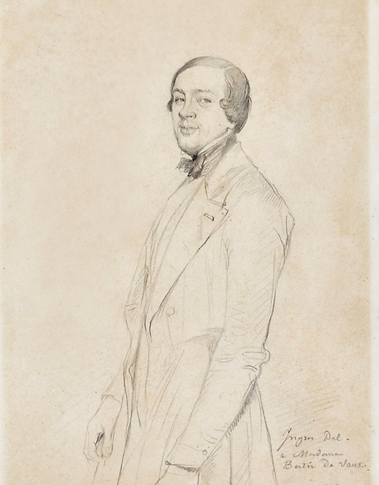
Count Alphonse de Rayneval
drawn in 1844 by Jean-Auguste-Dominique INGRES

V. THE COUNT AND COUNTESS HENRY DE SAINT SEINE,
The Art of Living during the Belle Époque
The union of Madeleine de Rayneval (1851-1880) — daughter of Louise and Alphonse de Rayneval—with Count Henry Le Gouz de Saint Seine (1844-1915) marked a key milestone in the estate's history. By bringing the Saint Seine name to Grand'Maisons, this marriage inscribed the château into the continuity of the great families of the French nobility.
During this era, the estate lived to the rhythm of 19th-century "château life," cultivating a highly refined art of living that balanced high-society receptions with rigorous land management. Despite the early passing of Countess Madeleine at the age of 29, Count Henry de Saint Seine devotedly ensured the continuity of the family heritage for over thirty years. Under his care, Grand'Maisons preserved its brilliance and its atmosphere as an aristocratic country residence, laying the groundwork for future generations.

Count Henry de Saint Seine
photograph circa 1875

Countess Madeleine de Rayneval
photograph circa 1875
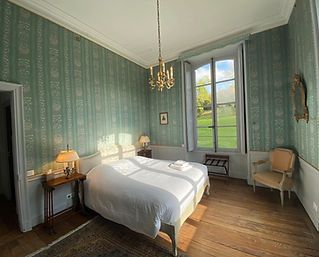
VI. THE COUNT AND COUNTESS THIBAULT DE SAINT SEINE,
Son of Madeleine and Henry de Saint Seine, Count Thibault Le Gouz de Saint Seine (1872-1949) navigated one of the most tumultuous periods of modern history with quiet strength. His union with Anne de Truchis de Varennes (1875-1938) consolidated the family heritage on the threshold of a century marked by profound upheavals.
A witness and actor of his time, he ensured the protection and permanence of Grand'Maisons through the trials of both World Wars. Under his guidance, the estate remained a sanctuary of stability and transmission, preserving the traditional family art of living amidst the chaos of history. For nearly half a century, Thibault de Saint Seine embodied the figure of the guardian of the temple, devotedly watching over the architectural integrity and the soul of the home inherited from his ancestors, before passing the torch to his daughter Simone at the end of the Second World War.

Count Thibault de Saint Seine
photograph circa 1895

Anne de Truchis de Varennes
photograph circa 1895

VII. THE COUNT AND COUNTESS ROLAND DE SAINT SEINE,
Simone Le Gouz de Saint Seine (1909-2010), daughter of Thibault and Anne de Saint Seine, wife of Roland Le Gouz de Saint Seine (1901-1974).
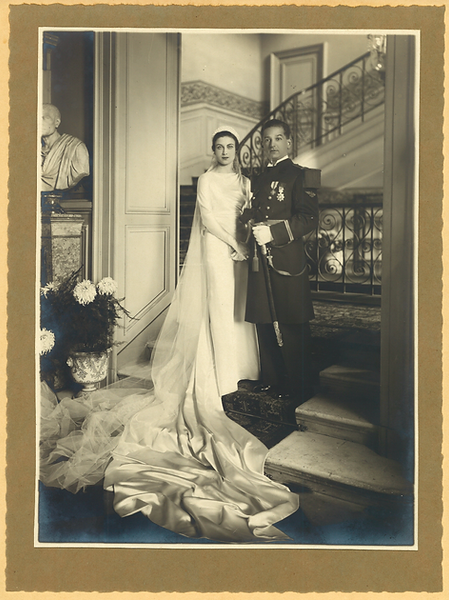
Simone and Roland de Saint Seine
wedding photograph, 1929
During the Second World War, the château was occupied by German troops, who shared the premises with Augustine's descendants, who had moved there after leaving occupied Paris. Count Roland de Saint Seine performed an act of great bravery by hiding a British pilot on the estate who had successfully parachuted into the area. Having been denounced, Roland was sent to Nazi concentration camps, experiencing the desolation of Natzweiler, Gross-Rosen, and Dachau. He returned alive and was honored with the Cross of the Legion of Honor.
Testimony of Captain Roland de Saint Seine
At the end of the war, Simone de Saint Seine and her husband, Count Roland de Saint Seine, renovated and refurnished the château. As true pioneers, they launched a residential seminar business on the property.
As parents of four children, it was their son Luc who would take over the mantle of maintaining the estate.


VIII. THE COUNT LUC DE SAINT SEINE ,
The Architect of the Contemporary Estate
Deeply passionate about architecture and historic stone, Count Luc Le Gouz de Saint Seine (1938-2012), son of Simone and Roland de Saint Seine. began remodeling the Grand'Maisons farmhouse complex in the 1970s to create a magnificent venue for receptions.
By developing a high-quality event business there for nearly 40 years—hosting thousands of receptions, weddings, seminars, and corporate conventions within the 3,000 square meters of lounges in the farmhouse—Luc de Saint Seine achieved the feat of maintaining a financial balance that allowed for the continued restoration and embellishment of the Grand'Maisons estate.
As the second child in a sibling group of four, it would nevertheless fall to the next generation to seek solutions regarding the future of the family history at Grand'Maisons.

Count Luc de Saint Seine
photograph circa 1960

Count Luc de Saint Seine
photograph in 2004

IX. LUTZ & VICTOIRE LIEBRECHT DE SAINT SEINE,
A Commitment to Permanence
In 2017, Victoire de Saint Seine and her husband Lutz Liebrecht took over the direction of the event business and the management of the estate. Their arrival marked a necessary restructuring phase to meet contemporary requirements for conserving such a heritage.
In 2022, a major strategic decision was made. In order to concentrate all investments on the historic heart of the property, Lutz and Victoire chose to sell the farmhouse complex. This refocusing of business activities freed up the indispensable resources required for heavy restoration work on the Château and its outbuildings, as well as for the reunification of the estate.
These management decisions made it possible, starting in 2023, to launch large-scale projects: the complete overhaul of the château's slate roofs and the restoration of the two historic outbuildings, the East and West Pavilions.
Development continues today with the project for the new Orangerie, which plans to enhance the East Pavilion by creating a high-end reception space capable of hosting 300 guests. Through these rigorous choices, Lutz and Victoire are ensuring the financial stability and architectural future of Grand'Maisons.
